Rhodites rosae
Cynips rosae
Diplolepis bedeguaris
Diplolepis rosae
Diplolepis bedeguaris fungosae
Hosts: Rosa rubiginosa; it has been recorded from eighteen species of rose, and is likely to be found on almost any of the species.
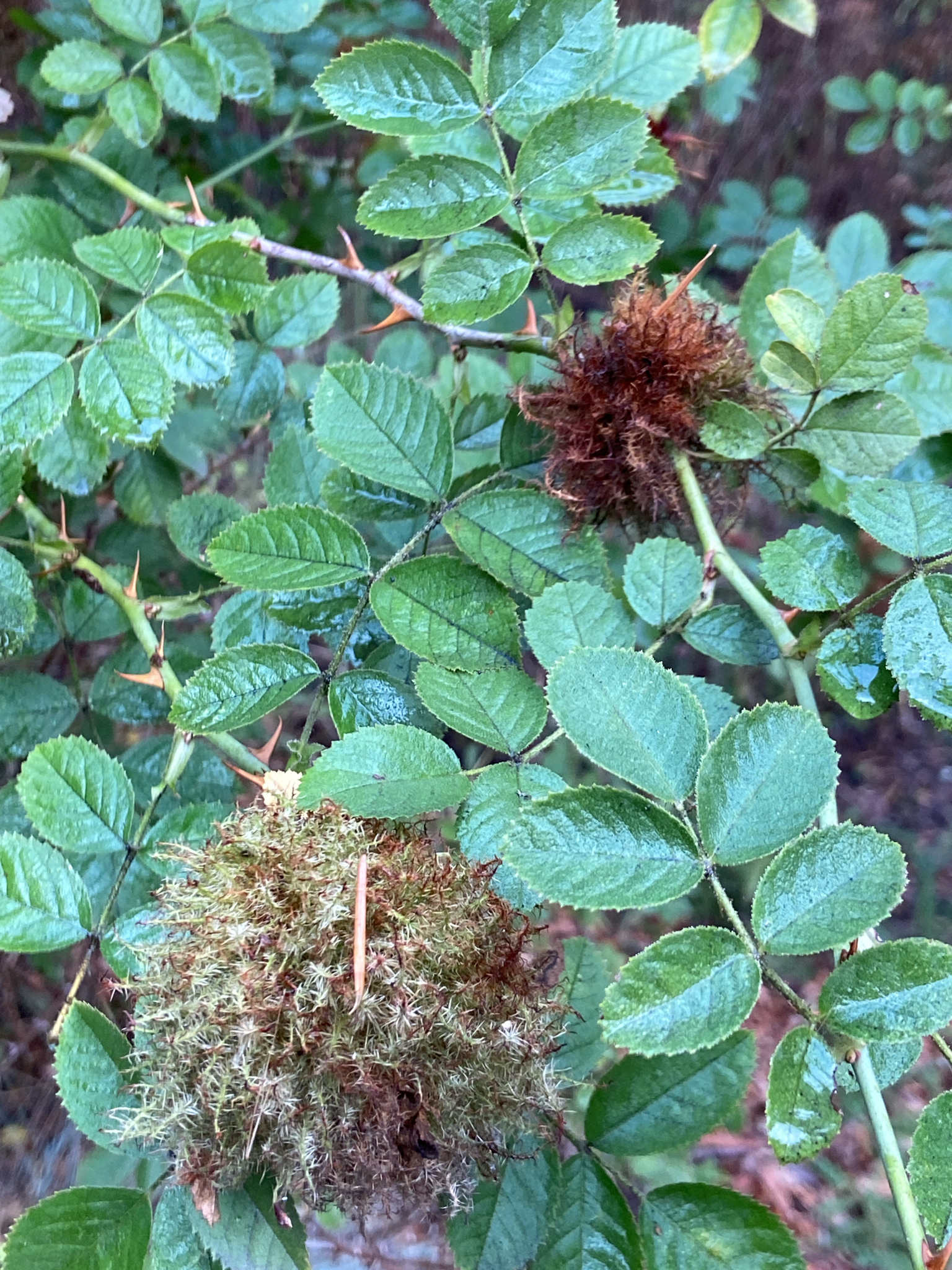
Gall. A large mass (Figs. 3 and 4) of moss-like filaments surrounding a cluster of hard, bud-like cells. The filaments are pale green or reddish or purplish- tinged when young, becoming brown or black during the winter; they are sometimes simple, forming a tangled mass, or may be broad, branched, or leaf-like; the whole gall is spherical or oval, about 50 mm. or less in diameter. Each cell of the central core is a modified bud, monothalamous, thick-walled, with a distinct but inseparable larval cell; the cell is more or less covered with irregular projections; and often several cells fuse. Terminal on the stems of roses, especially of the sweet briar; it has been recorded from eighteen species of rose, and is likely to be found on almost any of the species.
Range: Toronto, Quebec, New England to Georgia, west to Michigan, Kansas, and Colorado
The species is evidently of European origin, probably having been imported in North American and other parts of the world on the sweet-briar.
The gall is a curious modification of the young leaves. It is among the most specialized of the Rhodites galls. But what has been gained by the specializaton is not altogether apparent, for the amount of parasitism of this species is great (at least 15%), and evidently the peculiar devices which complicate the gall are of no avail in keeping out parasitic insects.
The galls of rosae appear as early as June 5 (Adler, 1877), about three weeks after the eggs are laid; these galls are well grown in late July and mature by September. The insects overwinter as larvae and pupate only a few days before their emergence from the gall. The adults emerge from April 27 to July 9. This is a wider range of dates of emergence than is commonly found among the Cynipidae and, unlike practically all of the other gall-wasps, adults of this species will sometimes emerge from a single gall at two or more dates separated by a month or more, indicating a considerable range of differences between the eggs from a single parent. The adults oviposit within a few hours after emergence but may live for four or five days before dying.
Males and females are sometimes produced in about equal abundance. From my first lot of material I bred six females and seven males, and Cameron reported (1889) a similar experience. But other galls will give no males at all, indicating a great variation in the eggs laid by different individuals. The final average gives between one and two per cent males, and the observations of several workers (Adler, 1888; Cameron, 1889; et al.) confirm my experience in this respect. It is to be expected that under such conditions the females are often not fecundated but, nevertheless, the eggs of such individuals will grow parthenogenetically. This was very positively proved by Adler (1877), who secured galls from eggs he had observed to be laid in the plant. He conducted extensive experiments with this species; in four different years he obtained similar results, rearing three generations in direct succession, obtaining galls and adults in each case exactly like those of the parent generation. This was conclusive proof that there is no alternation of generations with this species, and nothing known of its life history would suggest that an alternation ever occurs. By strictly isolating the females from the males at emergence and before oviposition, and by anatomical examination of the receptaculum, Adler proved the parthenogenetic development of eggs.