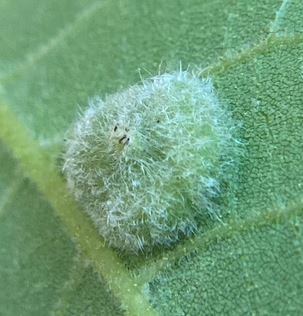
Phylloxera pilosula Pergande, n. sp.
The galls of this species are very unique and readily distinguished from any others so far observed. They occur usually on solitary trees of Hicoria glabra along the Potomac near Washington. They are usually quite abundant though rather sparsely distributed, there being but one, or rarely more than 3-6, upon a leaf and seldom so close together as to become confluent.
When first found, May 23rd, they were already fully developed, but contained, besides the stem-mother, only eggs and larvae. Ten days later most of the insects had already acquired wings. The transverse diameter of the gall varies between 3-6 mm, and their height to the tip of the nipple 2-3 mm. They are quite flat above, even with the surface of the leaf or but slightly projecting above it. In the latter case they are usually surrounded by a somewhat depressed ring and have a slight inclination to one side. There is always a more or less distinct shallow depression at the middle, which is usually quite densely covered with rather long, faintly yellowish, soft and glistening hairs. On the under side they resemble somewhat those of the variety Ph. c. -symmetrica, though they are more evenly convex and provided with a rather long and slender nipple, which is split into five to six, or rarely more, slender filaments, which usually lean to one side. This nipple, as well as the surface of the gall, is quite densely covered with long, glistening and faintly yellowish hairs similar to those on the upper surface. This pilosity of the gall is quite in contrast with the otherwise perfect smoothness of the leaves above and beneath. The upper side of the galls is of a paler green than the leaf itself, with a slight tinge of yellow, whilst on the underside the color merges gradually from pale green at its circumference to almost white at the nipple. The walls are quite solid and rather stout at the base. The galls are almost per- fectly white on the inside and semi-transparent.
Read more...
License:
Public Domain / CC0